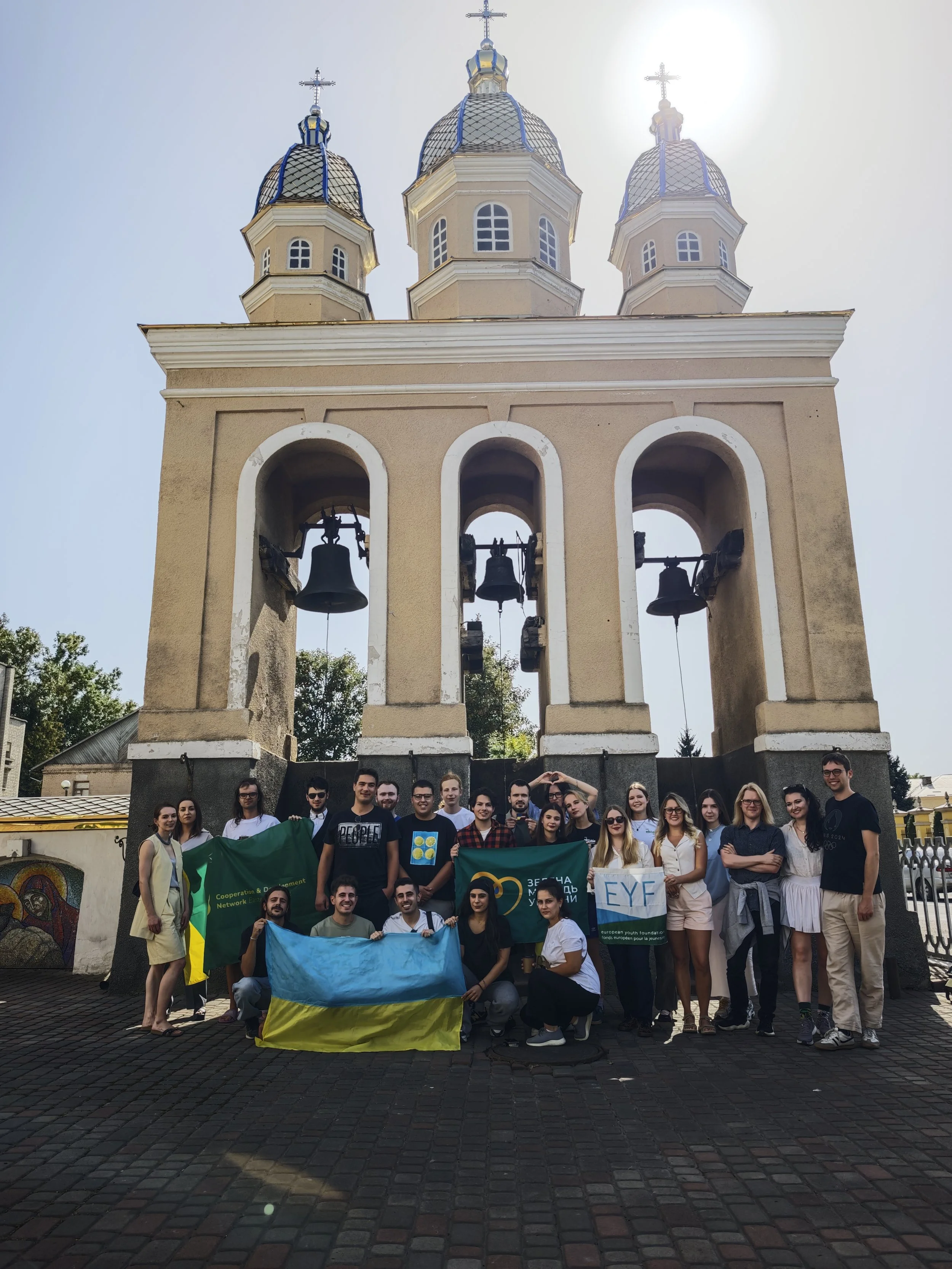
International Activity “Environmental Consequences of War: Monitoring and Overcoming”, took place from 26th – 30th of August 2025 in Sheptytskyi, Lviv Oblast, Ukraine.
CDN gathered 25 young people from Ukraine and Europe to work together in the International Seminar “Environmental Consequences of War: Monitoring and Overcoming”. During the event, participants explored how russia’s aggression impacts our environment, democracy, and human rights — and learned how to make our environment more resilient. Over 2025 and 2026, CDN disseminated the results of the activity in the form of posts and webinars.
With this activity, we aim to empower and mobilize 25 young people for cross-border cooperation in spreading the awareness of the environmental consequences of Russian aggression on Ukraine, and its cross-border effects on youth, democracy and human rights by providing them with space, theoretical knowledge and skills necessary to advocate for their rights related to the environment on the local, national and European level. The Objectives of this activity are:
Enhancing the understanding of 25 young people about the environmental consequences of war in Ukraine, the environmental protection during the times of war, and its connections with the energy sector, democracy and human rights.
Providing 25 young people with the knowledge and skills related to campaigning and awareness raising of the Russian aggression of Ukraine and its impact on young people and environment.
Providing 25 young people with the skills necessary to participate in the political process regarding environment protection, energy transition and resilience at the local, national and international levels.
Strengthening the cross-border and international cooperation of young people in dissemination of the knowledge about them among their peers.
-
The project tackles the issue of low social awareness of environmental damage caused by Russian aggression of Ukraine and the low level of youth knowledge skills to advocate for the protection of the environment caused by war and its consequences in the whole of Europe.
As of April 2024, over 2000 cases of potential environmental damage were recorded since the beginning of the war by the Center for Environmental Initiatives Ecoaction. Only in 2024, 35 cases of severe environmental damage were documented. Moreover, additional greenhouse gas emissions caused by warfare, reconstruction, damage to environment and infrastructure in three years of war reached 230 million tonnes of CO2 equivalent, about 8% of EU-27 emissions in 2024. The environment is thus the silent victim of the war.
Youth are most affected by environmental damage as they will bear the long-term consequences of polluted ecosystems that will threaten their health, livelihoods, and future opportunities even after achieving sustainable peace. Moreover, the problem is for youth in the whole of Europe: the environmental consequences of the war are often cross-border and need to be tackled at the European level. These are direct consequences, as pollution in the Danube and the Black Sea, to less and more indirect, as neighbouring countries withdrawing from the Ottawa convention, potentially mining the naturally valuable border areas.
With this activity, a 5-days international seminar, the youth activists will learn to mainstream and spread the knowledge about environmental consequences of war and need to counteract them, and to participate in the political process regarding the protection and resilience of environment.
-
Sheptytskyi is a city that can be an example for well-led processes of the just transition, despite the war-related issues (e.g., the city offered huge help to the internally displaced people). This historical mining town of around 80000 inhabitants has 5 operating mines, one in the process of liquidation, and one already liquidated. In 2023, 40% of revenues of the municipality came from the extractive industry.
The Just Transition Action Plan was developed in 2023, meaningfully engaging the citizens. Three focus groups (economic development, ecology and environment and human capital) consisting of 420 participants were created. Residents submitted 130 project ideas.
As a result of the plan, 38 projects will be realised, resulting in, among others, 1348 new jobs, over 40.000 MW of newly installed renewable energy facilities, 5 hectares of revitalised and reclaimed areas, all benefitting 220.000 residents in the municipality and the region. One of the projects focused on the solar power plants for the three water intakes in the municipality, so they are provided with uninterrupted power supply. Other examples include the successful transition of former miners who, with the support of the program, opened sustainable local businesses.
From the notes of one of the participants on the session “Just Transiition in Sheptytskyi” during the activity. Big thanks for the Just Transition Agency in Sheptytskyi for conducting of workshop and informative presentation.
-
During the follow-up of the activities we prepared 2 online campaigns.
The campaign STOP ECOCIDE can be found at the website. The publication for th

Here you can find the draft agenda for the event:
The event is supported by the European Youth Foundation of Council of Europe as the part of Special call for help young people in Ukraine.