
Isn’t this a European problem?
Because a sabotage or cyberattack on critical infrastructure cannot be treated as a local incident – it is a matter of European security and needs to be treated as such.
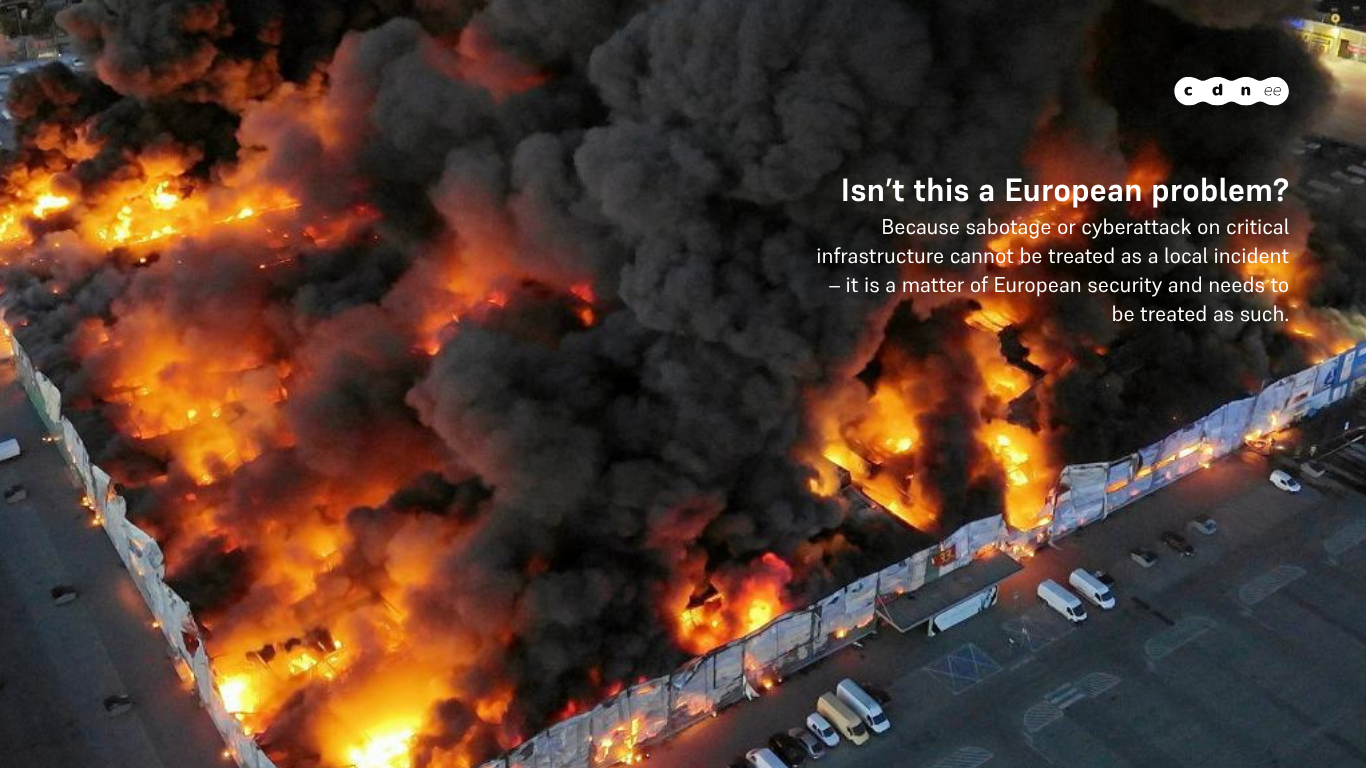
Over the past few days, we have witnessed russian sabotage activities in Europe: in Poland, two defence-related plants were set on fire, and in Germany, two attacks on the power grid took place. In Germany, russian drones carrying explosives were found at Leipzig/Halle airport. Similar attacks have also occurred in Estonia (attack on Milrem Robotics) and Bulgaria (attack on arms warehouses) in the past month - in these cases, russian involvement has not yet been confirmed, but they are consistent with russia's hybrid warfare strategy.
This would not be the first time russia has treated European critical infrastructure as a military target, employing terrorist tactics. It has repeatedly carried out cyberattacks and sabotage on critical infrastructure in recent years, including attacks on the Polish power grid in December 2025 by a cyberwarfare unit of russia's intelligence, which, if successful, could have left half a million people without electricity.
Such attacks not only directly threaten critical infrastructure and people, but also can reinforce polarisation and create space for disinformation even with an appropriate response and investigation by intelligence agencies, or deter allies from maintaining permanent military bases. The chaos would be additionally intensified by the political context: the election campaign in Latvia and the wave of anti-Ukrainian propaganda by Polish right-wingers, and the inaction of the EPP government.
At the same time, russia has intensified its terror against Ukrainians: only in July, 437 civilians were killed and 2610 injured in russian attacks. Russia has stated its goals clearly in 2021, and continues to repeat them: the complete subjugation and imposition of Russian terror not only on Ukraine but also Eastern and Central Europe. No delusions from populists from the far right and far left about a possible shift in goals without a Ukrainian victory will change this: we need European solidarity and increased military and financial support for Ukraine.
CDN reiterates the need to prioritize stregthening the European resilience against hybrid threats, and safeguarding critical infrastructure against cyber-attacks and sabotages by constant updating legislations, standards and monitoring. More information can be found in our political platform, or one of our publications: "CDN Security Policy Toolkit" (2024) and "CDN Environmental Security Policy" (2026), available on our website.
