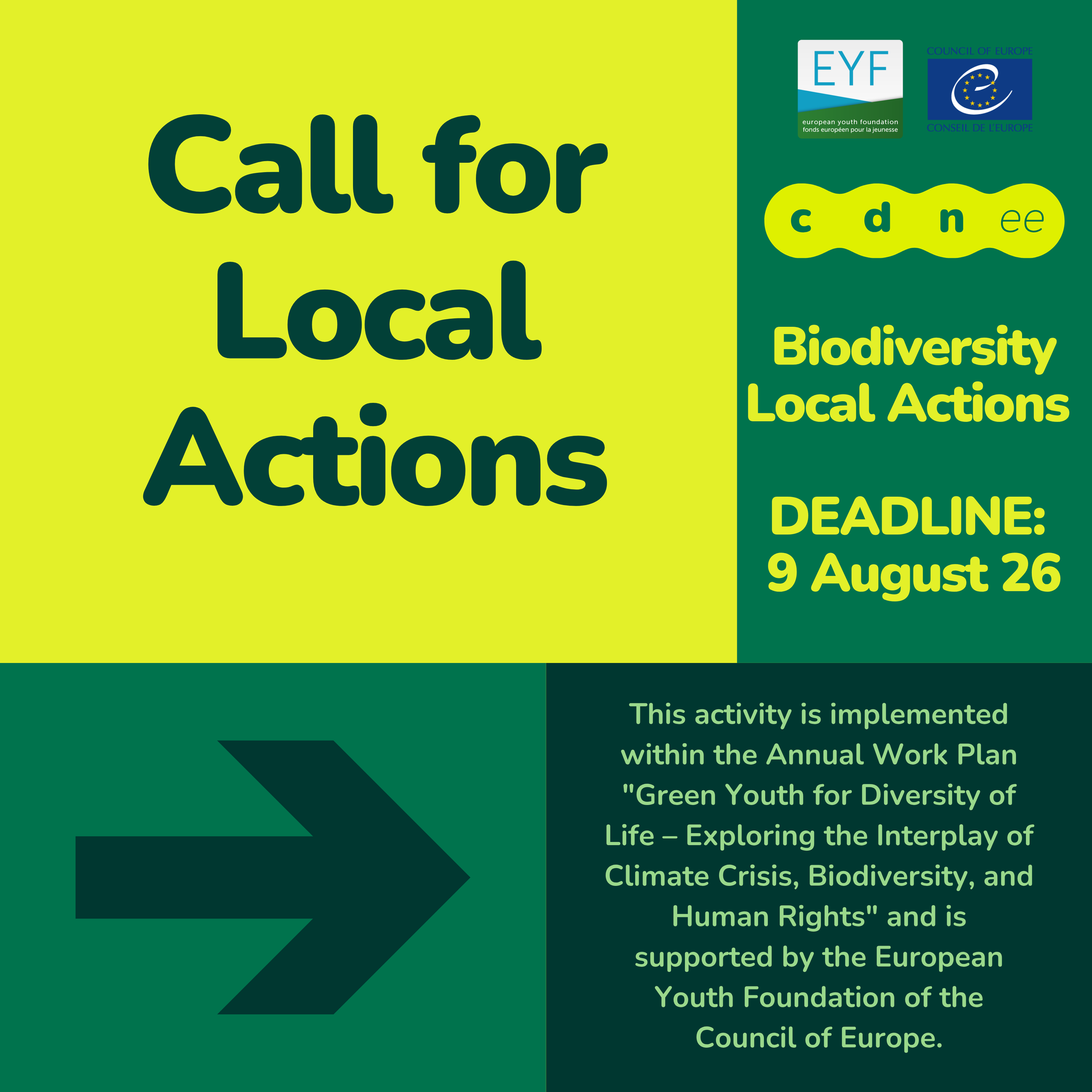
We are happy to announce that the call for applications for the second phase of our Annual Work Plan "Green Youth for Diversity of Life – Exploring the Interplay of Climate Crisis, Biodiversity, and Human Rights" is now open.
The call for Biodiversity Local Actions (LAs) is an opportunity for green youth organisations and youth groups whose representatives participated in the Biodiversity Summer Camp, as well as other eligible organisations within our network, to apply for funding by submitting a Local Action Plans together with the accepted Draft Budget.
About the Biodiversity Local Actions
The second phase of the Work Plan aims to enable green youth activists and organisations to take the lessons learned and skills gained during the Biodiversity Summer Camp and bring them to local and regional levels. Participants will transfer the knowledge and skills gathered during the first activity to their peers within their organisations and wider communities while organising activities related to biodiversity and human rights protection.
Therefore, this phase aims to enable green youth activists and organisations to increase their capacities in education, policymaking, and advocacy related to biodiversity and human rights protection in different contexts across Eastern Europe.
This will be achieved by:
Supporting 7 green youth organisations to apply the knowledge and skills learned during the Biodiversity Summer Camp and integrate them into the programmes and activities of their organisations.
Supporting 7 green youth organisations to organise educational, policymaking, or advocacy activities aimed at biodiversity protection, restoration, and the promotion of human rights.
Strengthening cooperation between green youth organisations across Eastern Europe, especially those gathered around CDN.
CDN will provide funding for 7 Biodiversity Local Actions through a 5-month period of preparation, implementation, and reporting.
During this period, Local Action organisers will implement knowledge and skills gained during the Summer Camp within their organisations, facilitate educational activities, develop policy proposals or advocacy initiatives, and contribute to biodiversity protection and restoration in their local contexts.
Local Actions should
The Local Actions should:
Be directly aligned with the Aim and Objectives of the Annual Work Plan.
Address the interplay between biodiversity, climate crisis, and human rights, with a focus on biodiversity protection and restoration.
Have clearly defined aims, objectives, expected outcomes, and target groups.
Demonstrate how the knowledge and skills gained during the Biodiversity Summer Camp will be applied within the organisation and local community.
Include at least one activity related to education, policymaking, or advocacy in the field of biodiversity and human rights protection, depending on the organisation's capacities and local context.
Encourage the dissemination of knowledge and resources to peers, members, and wider communities.
Use participatory, youth-led, and non-formal education approaches throughout the preparation and implementation of the Local Action whenever appropriate.
Involve young people from diverse backgrounds and promote meaningful youth participation throughout the project.
Consider local needs, political context, and organisational strengths when designing the action.
Funding
The CDN Office and Executive Committee will evaluate all applications and decide on the grants to be awarded.
Each selected organisation may receive up to EUR 2,760 to implement its Biodiversity Local Action.
Applications will be evaluated according to:
relevance to the objectives of the Work Plan;
quality and feasibility of the Local Action Plan;
expected local impact;
meaningful youth participation;
sustainability of the proposed activities;
realistic budget;
gender and inclusion dimension;
participation in the Biodiversity Summer Camp (which will be considered an advantage).
Responsibilities of selected organisations
Local Action teams will be fully responsible for implementing their projects together with the activists and participants they involve.
We strongly encourage representation and participation of all social groups, especially women, queer people, rural youth, displaced youth, and other young people exposed to marginalisation.
Local teams are encouraged to:
use non-formal education methods throughout the project;
apply CDN's Safe Space Policy during preparation and implementation;
involve additional experts whenever relevant;
contact CDN for methodological, contextual, or project-related support whenever needed.
If awarded a grant, applicants will be expected to:
participate in the online Kick-off Meeting;
begin preparations immediately after grant approval;
implement the Local Action according to the approved application and recommendations from CDN;
complete all project activities within the implementation period;
submit narrative and financial reports by the deadlines communicated by CDN;
organise and submit all invoices, receipts, and supporting financial documentation;
use the shared Nextcloud workspace for project documentation and reporting;
participate in dissemination activities organised by CDN;
ensure visibility of the European Youth Foundation, the Council of Europe, and CDN by using the required logos and communication guidelines;
share photos, videos, and communication materials from the Local Action with CDN.
How to apply
To apply, please submit:
the completed Local Action Application Form; and
the accepted Draft Budget.
Applications should be sent to project.coordinator@cdnee.org with the subject:
Biodiversity Local Action 2026 Application
Application deadline:9 August 2026, 23:59 CET.
Late or incomplete applications will not be considered.
Applicants will receive feedback approximately two weeks after the deadline.
If you have any questions regarding the call, please contact the CDN Project Coordinator at the email address above.
This activity is implemented within the Annual Work Plan "Green Youth for Diversity of Life – Exploring the Interplay of Climate Crisis, Biodiversity, and Human Rights" and is supported by the European Youth Foundation of the Council of Europe.


